Issue 9 of 12
The camera is visible. The network is not.
At least 56 plate-reading cameras now watch Delaware County's roads for four public agencies, and the county commissioners signed the sheriff's contracts themselves. Each camera feeds a national network of more than 120,000, searchable by thousands of agencies. These systems find stolen cars and missing children, and they have also been used to track an abortion patient, exes, and immigrants. Ryan's position is conditional: serious uses, strict verifiable guardrails, and no blank checks. This page tells the whole story, both sides of it, with every claim sourced.
Start with what a Flock camera is ↓490,577
Unique plates the City of Delaware's 17 cameras logged in one 30-day window this year, generating 674 hotlist hits. How many hits were verified or led to action has not been published.
The Delaware Source, June 10, 202656
The working minimum count of public plate-reading cameras contracted or approved across four Delaware County agencies. Private neighborhood cameras are on top of that.
Compiled from public contracts and journals, July 2026$141,000
The known floor of recurring annual public cost (city, sheriff, and Powell subscriptions alone), before the sheriff's six-camera expansion and contracts not yet located.
Public contract records, compiled, 2024-2026Chapter one
What a Flock camera actually is.
The debate makes more sense once you see that the camera is only step one. The system is a pipeline that turns a photograph into a searchable, shareable record.
From camera to network, in six steps
1
A car passes
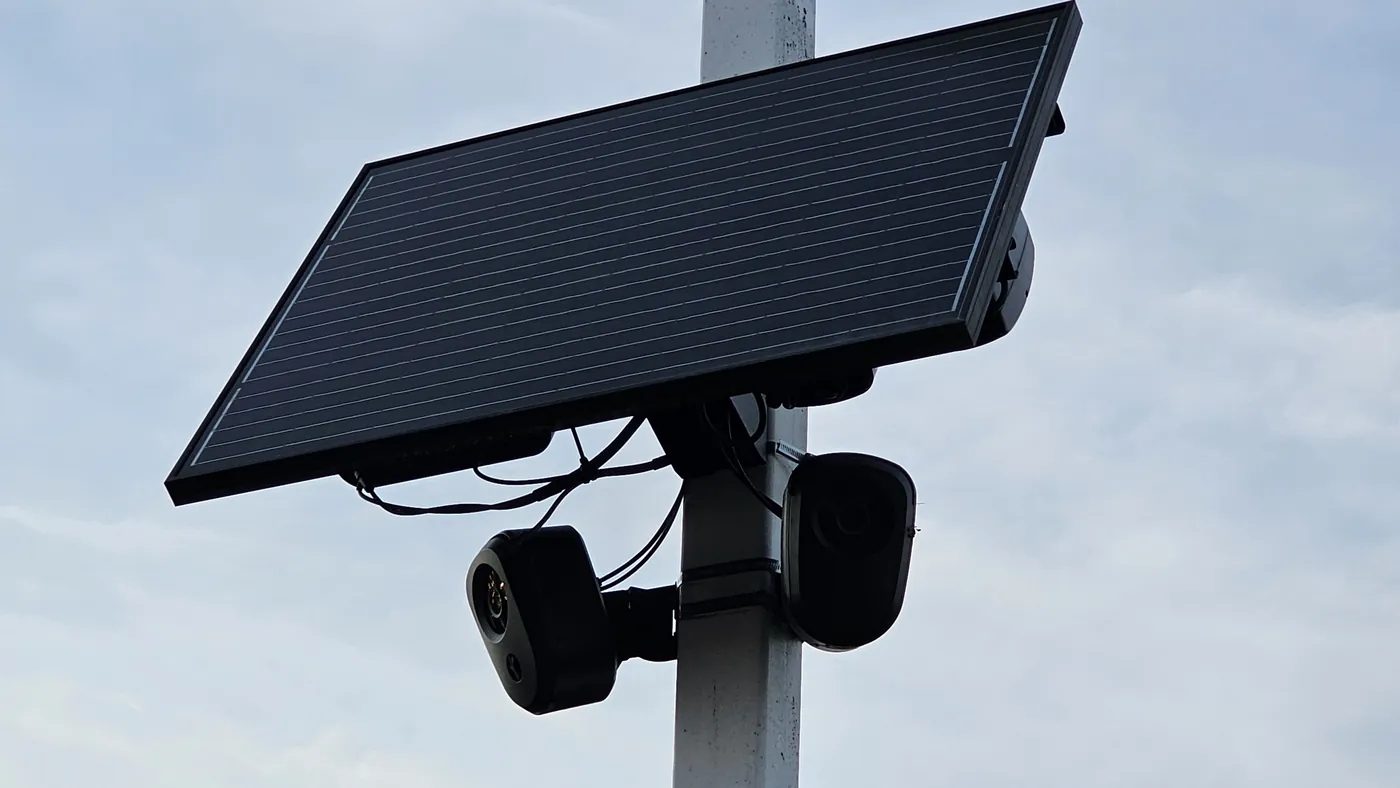
The solar, cellular camera photographs the rear plate.
2
It becomes data
Software reads the plate and logs make, color, time, place, and direction.
3
It goes to the cloud
The record joins a database the agency subscribes to, not a tape in a drawer.
4
Lists are checked
Stolen-car and wanted lists can trigger instant alerts to officers.
5
It can be searched
Investigators can later query a plate, a partial plate, or "red truck, damaged bumper."
6
It can be shared
Depending on settings, thousands of outside agencies can search it too.
The company says its standard product does not use facial recognition, does not identify drivers, and records are deleted at the end of a retention period (its recommended default dropped from 30 days to 7 in August 2026). Those limits are real. They also do not settle the question: a record of where a vehicle appeared can reveal a life without ever seeing a face.
The past: a 50-year road to here
The explosion, in dated public counts
It took the company five years to reach 20,000 cameras; the next three and a half added 100,000 more. Communities went from about 400 in 2019 to more than 12,000 today. And Flock is one vendor of several (Motorola, Axon, Genetec, and Rekor sell similar systems), holding roughly 80 percent of the US market at an $8.4 billion valuation. Hover any bar for its source.
Chapter two
The present: what already watches Delaware County.
This is the working public inventory, compiled from contracts, journals, and local reporting. It is a floor, not a census: private neighborhood cameras and other vendors sit on top of it.
Public plate readers by agency (working minimum: 56)
20 installed since 2024, 6 more approved June 2026. Res. 24-361 and 26-455; $74,200 initial + $56,900 expansion.
Council approved December 2024. $62,050 initial; three-year agreement.
Contracted 2024; inventories differ on active count. $36,500 first year.
Announced 2022; runs with the Block Watch program. Contract terms not yet verified from township records.
One month, one city: the scale in three lines
Nearly half a million ordinary observations produced 674 alerts. The missing third line is the point: nobody publishes how many alerts were verified, false, or acted on. That denominator is exactly what an annual public report would supply.
How it got approved: two votes, verified from the journals
Resolution 24-361 · May 2, 2024
Original three-party Master Services Agreement (Sheriff, Commissioners, Flock Group): 20 cameras, $74,200 initial, about $60,000/year. Vote: unanimous, 3-0.
Resolution 26-455 · June 29, 2026
First Addendum, Quote Q-196516: six more cameras for $56,900. Vote: Benton aye, Lewis aye, Merrell absent.
Both passed as routine contract business among dozens of resolutions, without a dedicated public hearing. That is normal procurement. Whether a searchable movement network should be normal procurement is the question this page exists to raise.
Chapter three
Both sides, at full strength.
The same two properties, speed and scale, produce every story below. The technology does not choose which kind happens. Rules do.
When it works
A missing girl, found. A Lucas County alert helped deputies spot the right vehicle during a traffic stop in July 2026.
Stolen cars, recovered. The sheriff credits 25 recoveries and 19 arrests here since 2024; Delaware police intercepted a stolen vehicle with spike strips.
Serious cases, corroborated. Delaware police used plate data to support a $100,000 elder-fraud case and confirm a route in a sexual-assault investigation.
Manhunts, narrowed. Multistate camera networks helped investigators trace movements after the Brown and MIT shootings.
When it fails
One search, 83,345 cameras. A Texas deputy swept the national network in a case tied to a self-managed abortion, logged as a welfare check.
Local rules, silently bypassed. Dayton found ~7,100 outside immigration-related search requests and suspended its whole program.
Credentials, abused. At least 50 officers nationally have been accused of misusing these systems, 26 to track partners or exes.
Errors, at traffic-stop speed. A Toledo misread ended in a wrongful stop and a $35,000 settlement; Lucas County's audit found 904,642 outside searches of its data in one month.
What the research actually shows
A peer-reviewed 2022 field experiment: more stolen vehicles recovered, no measurable deterrence, no arrest increase. A 2026 working paper across 216 agencies: vehicle theft down about 11 percent, clearance up about 16 percent, not yet peer-reviewed. And across the network, far less than 1 percent of scanned plates relate to any alleged wrongdoing. The fair summary: a real investigative aid whose broad crime-reduction claims remain unproven. That argues for controlled use and honest measurement, not for a ban and not for a blank check.
Chapter four
The law is still catching up. Ohio is deciding now.
No court has settled whether a dense camera network needs a warrant, and Ohio has no plate-reader statute in force. The rules are being written right now, community by community.
The legal road, in five stops
How Ohio communities are deciding
kept with guardrails ended, suspended, or removing kept as is. Nationally, one tracker counts roughly 47 canceled contracts and 25 rejected proposals by mid-2026.
Straight answers
What people ask at the door.
What exactly does a Flock camera record?
It photographs each passing vehicle and converts what it sees into a searchable record: the plate, the time, the location, the direction, and vehicle traits like make, color, and a roof rack or bumper damage. The company says its standard product does not use facial recognition, does not identify drivers, and is not a live video feed. Those limits are real, and they do not end the question, because a record of where your car appeared can reveal where you live, work, worship, and get medical care without ever seeing your face. The camera on the pole is one piece; the searchable network behind it is the system.
Who runs the cameras in Delaware County?
Four public agencies, at least 56 cameras. The Sheriff's Office runs 20 with 6 more approved (the commissioners signed both contracts: Resolution 24-361 in 2024, unanimously, and Resolution 26-455 this June, 2 to 0 with one member absent). The City of Delaware police run 17, Powell contracted 10, and Genoa Township announced 3 in 2022. Sunbury has been mentioned in reporting but no contract could be located, so this page does not count it. Private neighborhood and business cameras exist on top of all of that. Known public subscription costs already total at least $141,000 a year.
What has gone right?
Real cases, close to home. The Sheriff's Office credits its cameras with 19 arrests, 25 recovered stolen vehicles, and about $70,000 in recovered property since 2024. Delaware police used theirs to intercept a stolen car with spike strips, to support an elder-fraud case involving roughly $100,000, and to corroborate a vehicle's route in a sexual-assault investigation. In Lucas County, an alert helped deputies find a missing girl during a traffic stop. For stolen vehicles and missing people, the speed is genuinely hard to replace.
What has gone wrong?
Documented failures, not hypotheticals. A Texas deputy ran one search across 83,345 cameras nationwide in a case tied to a self-managed abortion. Dayton suspended its whole program after finding about 7,100 outside immigration-related search requests and safeguards that were never switched on. The Washington Post found at least 50 officers accused of misusing these systems, 26 of them to track partners or exes. A misread in Toledo produced a wrongful stop and a $35,000 settlement. And Lucas County's one-month audit found 904,642 searches of its data by 3,241 outside organizations. None of that happened here, so far as public records show. All of it happened on the same network Delaware County's cameras can join.
Do the cameras actually reduce crime?
The honest answer: they help investigations more clearly than they prevent crime. A peer-reviewed 2022 field experiment found more stolen vehicles recovered but no measurable deterrent effect and no increase in arrests. A larger 2026 working paper found motor-vehicle theft down about 11 percent and clearance rates up about 16 percent after adoption, but it is not yet peer-reviewed. Civil-liberties analysts note that far less than 1 percent of scanned plates relate to any alleged wrongdoing. A real investigative aid with unproven broad deterrence: buy it, if at all, for what it demonstrably does.
Can the commissioners just turn them off?
No, and any candidate who promises that is overpromising. The sheriff is independently elected and controls the program; the commissioners hold the money and signed the contract. Lucas County shows the limit: commissioners there voted to rescind their sheriff's Flock contract, the sheriff refused, and the county prosecutor deemed the rescission void. What a commissioner genuinely controls is the appropriation, the contract terms, the renewal, and the daylight: hearings instead of consent-agenda votes, audits instead of assurances. That leverage is real, and it is the honest ground this campaign stands on.
Where can I check this myself?
The City of Delaware publishes a Flock transparency page with camera counts and live statistics. The county commissioners' journals, posted at co.delaware.oh.us, contain both Flock resolutions in full; this page links them. Ohio's public records law lets you request contracts, policies, aggregate usage, and audit records from any agency, though the raw plate data itself is excluded from public records by state law. And the commissioners meet Monday and Thursday mornings at 9:30 at 91 North Sandusky Street, where every future camera dollar gets voted.
Levers and limits
What a commissioner can actually do about surveillance.
More than the light version of this page could say, now that the contracts are on the table: the commissioners' own signatures are on both sheriff's agreements.
The board controls
The contract and the money. The sheriff's Flock agreement is a three-party contract that the commissioners signed and fund. Resolutions 24-361 and 26-455 prove the board's seat at this table. Terms, conditions, reporting requirements, and renewal all run through that signature.
The process. Nothing requires camera expansions to pass as routine contract items. The board can commit to noticed public hearings and recorded roll calls for every surveillance purchase, and can demand a data-flow answer sheet before any vote: what is collected, who can search it, how long it lasts, and what proves the settings match the policy.
The conditions. Appropriations can carry strings: retention limits, case-number requirements, sharing restrictions, sensitive-use blocks, audit rights, annual public reporting, and verified deletion at termination. Flock's own August 2026 overhaul made most of these settings available; requiring them is now practical, not radical.
The county's own standard. A vendor-neutral surveillance policy for county-funded technology, written to survive a different sheriff, a different vendor, and a different political climate, is entirely within the board's authority.
The board does not control
The sheriff's operations. The sheriff is independently elected and runs the program day to day. Lucas County tested the boundary: commissioners voted to rescind their sheriff's contract, the sheriff refused, and the county prosecutor deemed the rescission void. The durable lever is the next appropriation and renewal, not a mid-contract showdown.
City, township, and school contracts. Delaware, Powell, Genoa Township, and Sunbury each answer to their own voters for their own cameras. The county can convene and publish; it cannot override.
The other vendors. Canceling one brand does not dismantle the capability. Axon, Motorola, Genetec, and private camera networks offer the same functions, which is why the rules must be written about capabilities, never about a logo.
Courts and the state. The Norfolk appeal may set the constitutional line, and the General Assembly may finally pass an Ohio statute. Until then, local contracts are where the rules live.
Ryan's position, in full
"Flock cameras can be useful. They can also create a searchable record of where ordinary people travel. I will not treat that as an ordinary equipment purchase. Serious cases, short retention, narrow sharing, human verification, public reporting, independent audits, and regular reapproval should be the minimum. If an agency or vendor will not accept those terms, taxpayers should not fund the system."
The plan
What Ryan will do.
No blank check. No black box. No automatic renewal.
No blank check: hearings and conditions before dollars.
Every surveillance purchase or renewal gets a noticed public hearing and a recorded roll call, never a routine consent item. County funding comes with written conditions: enumerated serious purposes, seven-day or shorter routine retention, a case number for every search, default national sharing off, and blocks on reproductive-care, civil-immigration, and First Amendment searches, enforced in the software settings, not just the policy binder.
No black box: an annual public surveillance report.
Delaware County should publish what Lucas County had to audit its way to: who searched our data, how often, for what, from where, with false alerts, misuse findings, outcomes, and total cost. Verified against the active configuration, because Dayton proved a policy on paper means nothing if the settings say otherwise. The missing denominators on this very page are the first thing that report would fix.
No automatic renewal: sunset, evidence, reauthorize.
Authorization expires unless renewed in public, on evidence: what the system demonstrably did, what it cost over five years, what went wrong, and whether less intrusive tools now exist. The standard is vendor-neutral and capability-based, so it survives a different sheriff, a different company, and a different political mood. New capabilities (facial recognition, drones, private-camera feeds) require their own separate public approval, always.
If nothing improves
The network assembles itself one reasonable contract at a time, each vote routine, until the county has built a searchable memory of ordinary travel that nobody ever decided to build. Then the first local misuse story arrives, trust breaks, and the county relives Dayton's scramble or Lucas County's standoff with no rules on the shelf. Communities that improvise under pressure tend to lose the tool and the trust together.
What better looks like
A county where the stolen car still gets found fast, and where anyone can read what the system collected, who searched it, and what it cost, every year, in public. Where the missing girl gets found and the abortion patient does not get hunted, because the settings, not the slogans, make the difference. The cameras keep their best uses. The county keeps its self-government.
Sources
Last updated: September 3, 2026
You should not have to take a candidate's word for any of this. The two county resolutions were verified directly from the journal PDFs; agency-reported outcomes are labeled as such; a few news sites block automated tools but load normally in a browser. Found an error? Tell the campaign and we will fix it.
Keep going.
What kind of memory is your government building? That question runs through more pages than this one.