Issue 8 of 12
Your 911 call gets answered in seconds. Keeping it that way is the actual job.
Public safety is the quiet success story of county government here. The 911 center answers faster than the national standard, the county's own EMS covers 459 square miles from 11 stations, and the sheriff's patrols are funded without drama. None of that is luck. It is capacity funded ahead of growth, and growth is the stress test: the sheriff's budget is up 51 percent in five years, a new EMS station is opening in Berkshire Township, and the 911 levy comes up for renewal this year. Ryan's job is to keep the funding ahead of the rooftops.
See the numbers ↓110,570
Calls the county 911 center handled in 2024, including 42,186 emergency calls. In 2022 it answered 99.7 percent within ten seconds, against a 90 percent national standard.
Delaware County Emergency Communications, 2024$43.4 million
The Sheriff's Office budget for 2026, up 51 percent since 2021, all from the county General Fund. The board writes the check; the independently elected sheriff runs the office.
Delaware County budget releases, November 24, 2025459
Square miles the county's own EMS covers with 11 stations and about 120 medics, funded from the General Fund by design, not a levy. Liberty Township and the City of Delaware run their own.
Delaware County EMS, 2026Heads up
The 911 levy runs out at the end of 2026.
The county 911 center runs on a dedicated 0.68-mill levy, about $19.38 a year per $100,000 of home value, raising roughly $4.5 million annually. Voters approved the current five-year version in November 2020, and it expires at the end of this year, which puts a renewal decision in front of the county. Residents in the Dublin, Westerville, and Columbus portions do not pay it, because those cities dispatch their own calls. Whatever the board proposes, the numbers behind it belong in public first.
Levy details from the county's August 2020 release, linked in the sources.
The data
A system that works, and what it costs to keep it working.
The clearest picture of growth pressure in public safety is not sirens. It is a budget line climbing year after year, from the county's own releases.
The price of protecting a growing county
Up 51 percent since 2021, all General Fund. The board writes this budget; the independently elected sheriff runs the office. Hover any bar for the exact figure.
The system at a glance
11
County EMS stations, plus a new one coming in Berkshire Township
~120
Full-time county medics with a 4-to-8-minute response target
13
Township and city fire departments, dispatched by the county 911 center
260
Sheriff's Office employees across patrol, corrections, courts, and administration
The call board: steady volume, fast answers
2019
2024
Volume has held roughly steady while the county grew, and the center answered 99.7 percent of calls within ten seconds in 2022. Growth pressure shows up in station maps and budgets before it shows up in call counts.
Straight answers
What people ask at the door.
Who answers when you call 911?
DelComm, the county's own Emergency Communications department, one of only a handful of nationally accredited centers in Ohio. It handled 110,570 calls in 2024 and dispatches 13 fire departments, the county EMS, and the Delaware and Powell police departments. It runs on a dedicated 0.68-mill levy, about $19 a year per $100,000 of home value. One wrinkle worth knowing: the Dublin, Westerville, and Columbus corners of the county run their own dispatch centers, and state law exempts those residents from the county 911 levy so nobody pays twice.
Who sends the ambulance?
For most of the county, Delaware County EMS, a department that answers directly to the commissioners: 11 stations, 11 advanced-life-support medic units, about 120 full-time medics covering 459 square miles, with a 4-to-8-minute response target. By its own deliberate choice it runs on the county General Fund rather than a property tax levy. The exceptions are Liberty Township and the City of Delaware, which run their own fire-based EMS. Fire protection everywhere in the county belongs to township and city departments, 13 of them, not to the county.
Who patrols my township?
The Sheriff's Office: about 260 employees patrolling the unincorporated townships, investigating crimes, serving the courts, and running the county jail on US 42. The sheriff is independently elected, which means the commissioners fund the office ($43.4 million in 2026) but do not direct it; only voters can do that. If you live in a city or village with its own police department, that department answers first, dispatched either by DelComm or, in the Dublin and Westerville corners, by their own centers.
What is the county building right now?
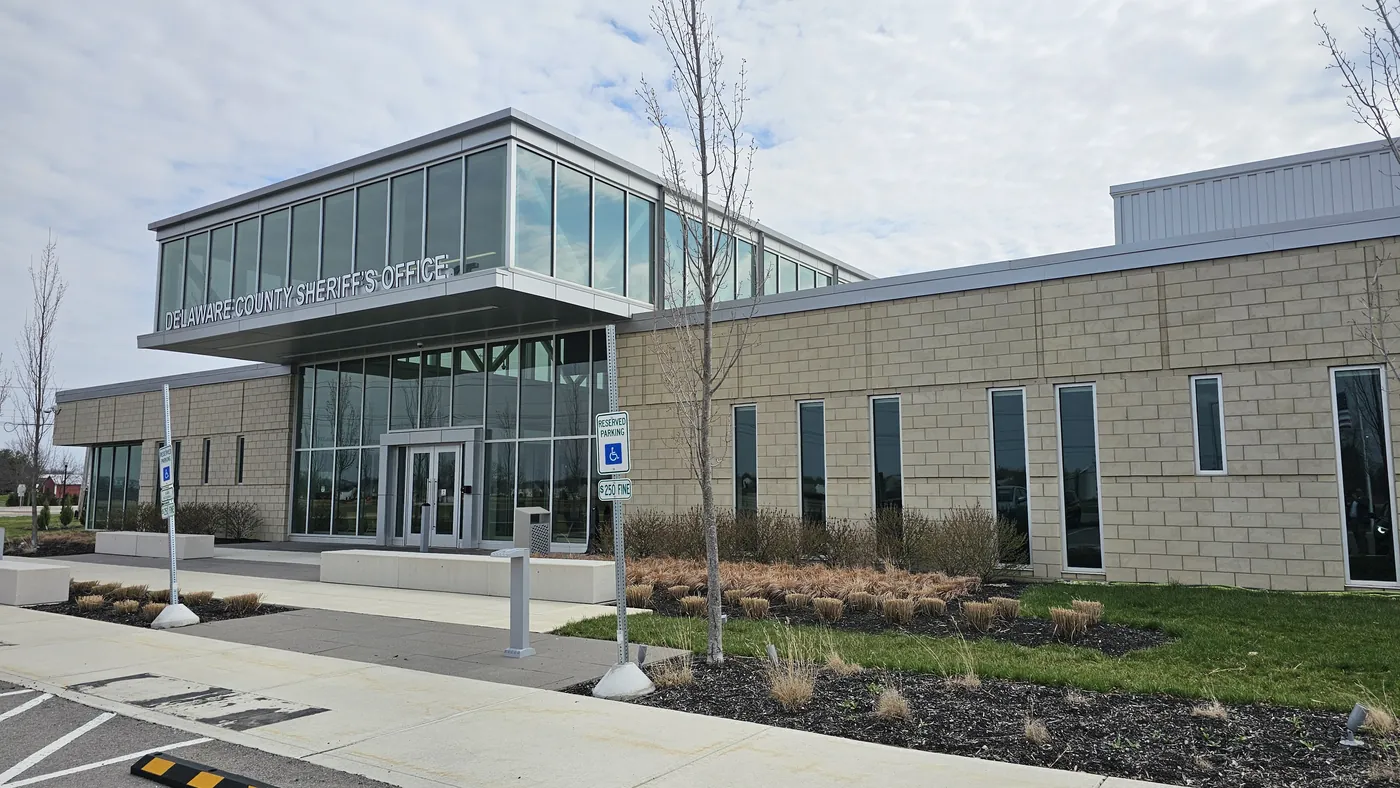
Two things worth knowing about. The Byxbe Campus on State Route 521, a $40.7 million project, gave the Sheriff's Office a new 34,000-square-foot administrative and patrol building in 2023. And the 2026 budget funds the staffing to open a new county EMS station in Berkshire Township, aimed at the growth corridor around Sunbury before response times feel it. Text-to-911 has been live since 2018.
What happens if nothing improves?
The arithmetic of growth catches up quietly. Every new subdivision adds runs and road miles between stations, and safety capacity that gets funded after response times slip costs more and arrives angrier than capacity funded ahead. The county has mostly stayed ahead so far: the Berkshire station is the model. The same discipline now faces a test with the 911 levy, which expires at the end of 2026 and puts a renewal decision in front of the county.
Where can I check this myself?
DelComm, county EMS, and the Sheriff's Office each publish their operations online, and every budget figure on this page comes from the county's own annual budget releases, all linked below. The commissioners meet Monday and Thursday mornings at 9:30 in the Historic Courthouse at 91 North Sandusky Street, and the EMS and 911 budgets go through that room.
Levers and limits
What a commissioner can actually do about public safety.
More than on most issues, actually: two of the three big pieces answer directly to the board. The third belongs to the voters.
The board controls
County EMS, entirely. The medics are a county department reporting to the commissioners: stations, staffing, equipment, and the decision to fund the new Berkshire Township station ahead of the growth around Sunbury. This is the board's most direct life-safety responsibility.
The 911 center and its levy. DelComm is a county department, and the board decides when and how the 0.68-mill levy goes back to the ballot as it expires this year. The renewal case should be made with published numbers, not slogans.
The sheriff's budget. $43.4 million in 2026, up 51 percent in five years, every dollar approved by this board. Funding the office honestly, and asking hard questions about the trajectory, is exactly the board's job.
Safety capital. The Byxbe Campus gave the sheriff a modern patrol headquarters; station siting and radio systems ride the county's capital budget. Buildings and towers are bought years before they are needed, or paid for twice after.
The board does not control
How the sheriff runs the office. The sheriff is independently elected. Patrol priorities, personnel, and the jail belong to that office, and accountability for them runs through the ballot, not the boardroom.
Fire departments. All 13 are township and city operations with their own chiefs, budgets, and levies. Genoa Township's department, for example, answers to Genoa's trustees, not to anyone at the county.
City police. Delaware, Powell, and the others staff and run their own departments. The Dublin, Westerville, and Columbus corners even dispatch their own calls.
Liberty Township and Delaware city EMS. Both chose to run their own fire-based EMS instead of the county service, and that choice is theirs to keep or revisit.
The plan
What Ryan will do.
Fund capacity ahead of the rooftops.
Put EMS coverage and response performance into the 10-Year Growth Impact Forecast, so the next Berkshire-style station gets planned from published data the day a growth corridor is approved, not after response times slip. The county has done this well; make it systematic instead of occasional.
Handle the 911 levy in daylight.
Before any renewal reaches your ballot, publish exactly what the levy pays for, what it costs your household, what performance it buys, and what happens without it. A center that answers 99.7 percent of calls in ten seconds has nothing to hide, so hide nothing.
Fund the sheriff honestly, respect the line.
A budget up 51 percent in five years deserves both support and scrutiny in public session: what growth requires, what it costs, and what the county gets. The board's job is the money and the questions, never pretending to run an office the voters staff directly. And the county's convening power belongs in use, bringing 13 fire departments, EMS, and dispatch to one table on growth planning.
If nothing improves
Excellence decays quietly. Stations that made sense for 180,000 residents stretch thinner at 240,000, budgets climb without anyone explaining why, and a levy renewal lands on ballots as a surprise ask instead of a documented case. Nothing dramatic happens for years. Then one bad response time becomes the story, and rebuilding trust costs more than the station would have.
What better looks like
A county where the safety map grows one step ahead of the subdivision map, on purpose and in public. Where the 911 levy renews or changes on published numbers, the sheriff's budget rises with a public explanation attached, and the quiet success story stays boring, which in emergency services is the highest compliment there is.
Sources
Last updated: September 2, 2026
You should not have to take a candidate's word for any of this. Every figure above traces to one of these sources, nearly all of them the county's own documents. Found an error? Tell the campaign and we will fix it.
Keep going.
Safety capacity is a growth decision made years before the siren.